Latest blog entries

Should I get a home battery?

Saturday, February 7th, 2026 at 01:55pm

Is has been over a year since I posted about my home energy usage, when I switched my electricity plan to a time of use plan.

So how has that gone? Courtesy of home assistant I have this pretty chart for 2025:
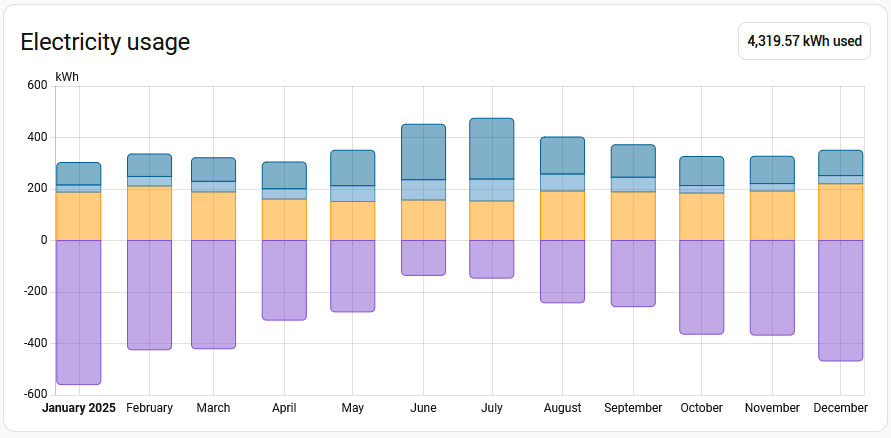
Combined with the other reporting, what does this tell me?

  • The total energy i used to get stuff done was 4.32MWh
  • My solar panels have generated 6.16MWh, I was only able to directly use one third, with 3.97MWh sent to the grid
  • I pulled 2.13MWh from the grid, 1.57MWh in off-peak and 0.58MWh in peak times
  • In a summer month I have heaps of excess solar, and overall use less energy (more daylight hours, only use the AC on the hotter days)
  • For a winter month I directly consume about half the solar, with overall more energy used (mostly because at least one AC unit will be heating a room when I am awake)

What does this translate to on my bills?

RateUsageCost
Daily charge$1.15/day365 days$419.75
Peak rate37.2c/kWh584.41 kWh$217.40
Off-peak rate22.3c/kWh1546.38 kWh$344.84
Solar rate3.1c/kWh-3971.23 kWh$-123.10
Total:$858.89

If I look back to 2023 I paid $1,853 for gas and $1,635 for electricity, a total of $3,488. That $858 figure is looking quite nice, it could be said that the changes I made at the end of 2023 (adding solar, removing gas) are saving me $2,500 each year.

I was curious about the impact of solar, so I ran the numbers to estimate what my bills would have been if I had only dropped gas (the addition of AC units) and replaced the hot water system. I likely still would have switched to a time of use tariff and then minimised my usage during peak times, for the calculation I will pro-rata the overall usage:

RateUsageCost
Daily charge$1.15/day365 days$419.75
Peak rate37.2c/kWh1184.57 kWh$440.66
Off-peak rate22.3c/kWh3134.43 kWh$698.98
Total:$1559.39

So based on these numbers, getting rid of gas just removed that bill from the equation. While the savings from switching to a heat pump for hot water were taken up by using the AC units (aka other heat pumps) for heating, with the bonus of now having cooling as an option.

So now back to the question of sending excess solar to the grid. In the two years since the installation the feed in tariff has dropped from 6c/kWh to 3c/kWh, if I were to change plans now it is down to a measly 1c/kWh.

So sending excess solar to the grid should be the last resort. I currently try to have all my large usage loads during the day when there is solar which is hot water, the dishwasher, the washing machine, half of my heating/cooling and more than half of my cooking. The remainder of the heating/cooling and cookie is in the evening, when there is no solar.

I don’t have an EV (yet…) but my car usage is mostly local a couple of times a week, so topping off its battery wouldn’t be significant.

So would it make sense to get a home battery?

Using this as my usage pattern:

Average dayConsumptionFrom gridFrom solarExcess solar
Summer12.1 kWh4.4 kWh7.7 kWh15.1 kWh
Winter15.3 kWh10.2 kWh5.1 kWh4.7 kWh

So what type and size of battery would fit with this usage?

I have yet to dig into the details of batteries but I have seen a number of examples using typical sizes of 6kWh and 10kWh. So in summer I could easily charge up a 6kWh or 10kWh battery from solar every day, only needing the capacity of 6kWh for my overnight usage. However in winter I would need a 10kWh battery to handle my overnight usage, which I would not be able to charge up each day.

Assuming I had a suitable battery, what would I save in grid costs?

In summer all my consumption might be able to be covered directly by solar or by the battery charged up by solar. Any pittance I get from excess solar would go towards offsetting the daily charge, in an ideal month the overall bill might be zero.

For a summer month with the ideal case of drawing nothing from the grid:

RateNo batteryWith battery
UsageCostUsageCost
Daily charge$1.15/day30 days$34.5030 days$34.50
Peak rate37.2c/kWh39.6 kWh$14.730.0 kWh$0.00
Off-peak rate22.3c/kWh93.2 kWh$20.780.0 kWh$0.00
Solar rate3.1c/kWh-454.3 kWh$-14.08-321.5 kWh$-9.97
Total:$55.93$24.53

That is looking promising, with the monthly bill in summer being halved, but with batteries looking to cost at least $8000, that is a 25 year ROI… and what about a winter month where all the excess solar goes into the battery to offset part of the grid usage?

RateNo batteryWith battery
UsageCostUsageCost
Daily charge$1.15/day30 days$34.5030 days$34.50
Peak rate37.2c/kWh85.3 kWh$31.7346.6 kWh$17.34
Off-peak rate22.3c/kWh236.3 kWh$52.69128.8 kWh$28.72
Solar rate3.1c/kWh-146.2 kWh$-4.53-0 kWh$0.00
Total:$114.39$80.56

Hmmm… I didn’t quite expect for the bill reduction to be around the same, and it might be an artifact of these specific numbers, but with the additional saving being so small it is not looking like a home battery would be a good option for me.

Apart from general chatter in news and other places about batteries, the one thing that triggered my thinking about it was an email from the company that installed my solar panels, I will see what they will suggest (with the awareness that they are trying to sell their services).
Tagged with: , ,

Back in Canberra for Everything Open

Tuesday, January 27th, 2026 at 09:11pm

Last week I drove up to Canberra for the fourth Everything Open conference the spiritual successor to linux.conf.au, this was fitting as the last time I was in Canberra was for LCA back in 2013. I did post about the first Everything Open back in 2023, and while I did attend the subsequent conferences in Gladstone and Adelaide, I didn’t write anything substantial up about those, I took the lazy approach of just tooting and boosting on Mastodon.

So now that it has been a few days, what are the topics that have stayed with me?

AI… of course…

There were a few talks about AI but there were also a number of ad-doc conversations. Unlike some of my co-workers, I didn’t encounter anyone that was exicted about AI. The mood was more cautious, while it could be a useful tool eventually or in specific circumstance, there is currently too much hype and slop.

The talks specifically about AI that I went to were:

Keir Winesmith’s keynote provided two alternate meanings for “AI” that resonated with how I have been feeling:

  • Archival Intelligence – in that it is only drawing from what we have already put into archives, you might get a response that is new to you, but it is not new to the person that previously wrote it
  • Averaged Inputs – responses are what is statistically likely, so they will be at the middle of the bell curve, not bad and not good, just an average of what has been provided before

Another ongoing topic of these conferences is a blend of digital rights, community and maintenance, things that are getting harder and harder in this capitalist world:

A couple of these overlap with my views on AI, such as the exited developer can now generate shiny code faster but they will still not be around to deal with maintenance, some code may be generated but has it also been documented for those in the future to maintain?

While writing up this post I also looked back over some previous posts about conferences and I was reminded of the talks about rockstar developers at LCA 2017 in Hobart. While previously to get away with being a rockstar a person needed to have decent skills and the excitement/drive/obsession to churn out shiny things, now it is the AI models that are doing the heavy lifting.

As for how the conference itself was run, it doesn’t compare against the peak of LCA, but there was talk that it is gaining momentum. While nothing is set yet, there are moves towards Brisbane 2027. If that happens, I will be there.

However for now I need to ensure that my photos from the drive up, around and back from Canberra do not fall into the backlog…

Tagged with: ,

Choosing not to automate

Friday, December 19th, 2025 at 06:12pm

The two bedrooms (one I use as my study) in my house (technically a unit) have large windows that face west. This means that they get full afternoon sun which can be a problem in the warmer months. Fortunately there is canvas awnings which do the simple job of keeping the direct sun off the window glass, the first layer of managing temperature.

Despite being the “automatic” type these awnings are operated manually. This naming comes from the 1970s and the awnings are the type on a spring loaded roll that you pull down, then lock in place on arms that extend out. Pulling down on the awning will unlock the arms and the awning rolls back up.

Diagram of automatic awning

The specific awnings I had were quite old, the canvas had been replaced by the previous owners and at least one mechanism looked like it was possibly original. Basically all the metal parts were either rusting or the paint was flaking off, so it had been on my list for a while to tidy it up in some way.

Until I recently went to use them for the first time this season and one of the plastic end caps disintegrated, making the awning unusable.

So now instead of of background job to tidy them up, I had the more urgent job of getting them replaced before the heat of summer kicked in. So I started to get quotes, but I didn’t just ask for one quote from each installer, I asked for the price to replace with the same automatic awning type and also for a price to replace with a motorized awning.

The quotes were fairly consistent: around $3k for automatic or around $6k for motorized. However that $6k did not include the cost of an electrician running power to each awning.

I also didn’t know what support the motorized awnings would have for integrating with home assistant, because if I was going to get something that could be automated, I wanted it integrated with what I already have.

Them I remembered something, with all the things I have done with home automation, almost everything have been monitoring. The only thing I control is the heating and cooling, mainly to have it on a schedule, and to turn it off if the exterior doors are open. So did I need to automate this? If I am home it is a simple task to pull them down, then later in the day (or if it rains or is very windy) go back out and raise them up.

It was also more than double (remember an electrician wasn’t included) the price, so I stayed with manually operated “automatic” awnings which were installed today:

Photo of two windows covered by canvas automatic awnings

Tagged with: ,

Repairing my Harmony 650 universal remote

Saturday, December 6th, 2025 at 11:11pm

Almost fifteen years ago I picked up a Logitech Harmony 650 universal remote to control my television, bluray player and whatever other media devices I might have connected. It was easy to setup and I didn’t need to change the config for many years.

Four years ago I found that my television could no longer play media using new codecs, so I switched over to a Raspberry Pi running Kodi. I was glad that I was able to reconfigure the Harmony 650 to add an MCE remote which the Kodi supported.

A year ago that original television died and I replaced it with another Samsung mainly because of what was available at a decent price. I mentioned at the time that the remote included with the new television was unusable, but fortunately the remote from the old Samsung television still worked, and which meant I only needed minimal tweaks to the config on the Harmony.

What I never got around to writing about was that a year earlier (so two years ago from now) some of the buttons on the Harmony 650 started to not respond all the time. As this is a really old model I started to look around for a modern replacement. I didn’t want something that required wifi and bluetooth or an app on my phone, I wanted a replacement that mostly used IR. I thought I had found the answer in the Sofabaton U2.

I did not:

  • it is configured via an app on a phone, which a number of times forgot all the previous config so I had to start from scratch
  • there are multiple options for an Windows Media Center remote, some didn’t work at all (so not MCE RC6?) and the ones that did work would be received by Kodi as multiple presses, no matter what config settings I tried
  • the macros and device selection looked promising, but I couldn’t get anything as nice as activities on the Harmony

I didn’t like the Sofabaton and eventually some of the key buttons on the Harmony stopped working, so for the last few months I have been using individual remotes: fifteen year old Samsung television remote, a HP MCE remote I picked up a while ago as a backup

Various remote controls from Samsung, Sony, Logitech, HP and Sofabaton

I don’t know how I didn’t come across this earlier, but I found that you can get replacement button membranes for the Harmony 650 remote (also other remotes).

Logitech Harmony 650 universal remote control and its replacement button membrane

That was my task this afternoon, and now the Harmony is working perfectly. This is what I should have done instead of wasting money on the Sofabaton…

Tagged with: ,

A long time between refreshes

Friday, August 15th, 2025 at 11:00pm

I remember a time when upgrading my home computer was a thing. Technology was changing fast enough that there was a benefit to regularly upgrading hardware and software. That was twenty years ago, these days things are fine and just work for years…

Two weeks ago I upgraded my main home desktop, upgrading to a Ryzen 7 9700X in what I felt was a mid range system that would give me a decent upgrade for a reasonable amount of money. With a basic motherboard, 32GB of RAM (double the previous system) and a new 500GB NVMe boot drive I kept it under AUD1000. The case and other storage (mostly SSD) was reused from the previous system. So far it is mostly the same, but the place where I can tell a different is in how much more responsive Lightroom now is.

That previous system was put together in early 2019 based around an i7-8700 CPU, it was my first system with an NVMe boot drive which did make it feel quite snappy. Though the other storage was all still spinning rust so there were still noticable read delays in Lightroom just after importing images (I made sure to put the catalog and cache on the NVMe drive).

I had thought that this six and a half year gap was the longest I had gone between upgrades, but it turns out that this is the second gap of this duration with the previous upgrade to an i7-3770 being almost thirteen years ago.

This trend of long gaps has been going for a while, I need to step back another four and a half years to when I previously switched from a series of AMD CPUs over to Intel. I don’t recall what I did with that hardware, it is all long gone as I had no need to keep it around.

However that thirteen year old i7-3770 is still running fine as my parent’s computer, but it is about to be updated to the six an a half year old i7-8700. Partially because I have no other use for it, but mainly because it is supported by Windows 11. It will also be a good time to remove all the spinning rust which has been in that system for a loooong time…

PS: Looking back through old posts I was reminded that at one point I did buy a dedicated GPU for Lightroom and did see a benefit from it, but these days I am happy with onboard graphics which support multiple monitors, it is a bonus if it might get used for Lightroom a bit. As I don’t play games I would need compelling evidence of a significant benefit before I would part with AUD500+ for a dedicated GPU.

Tagged with: , ,